
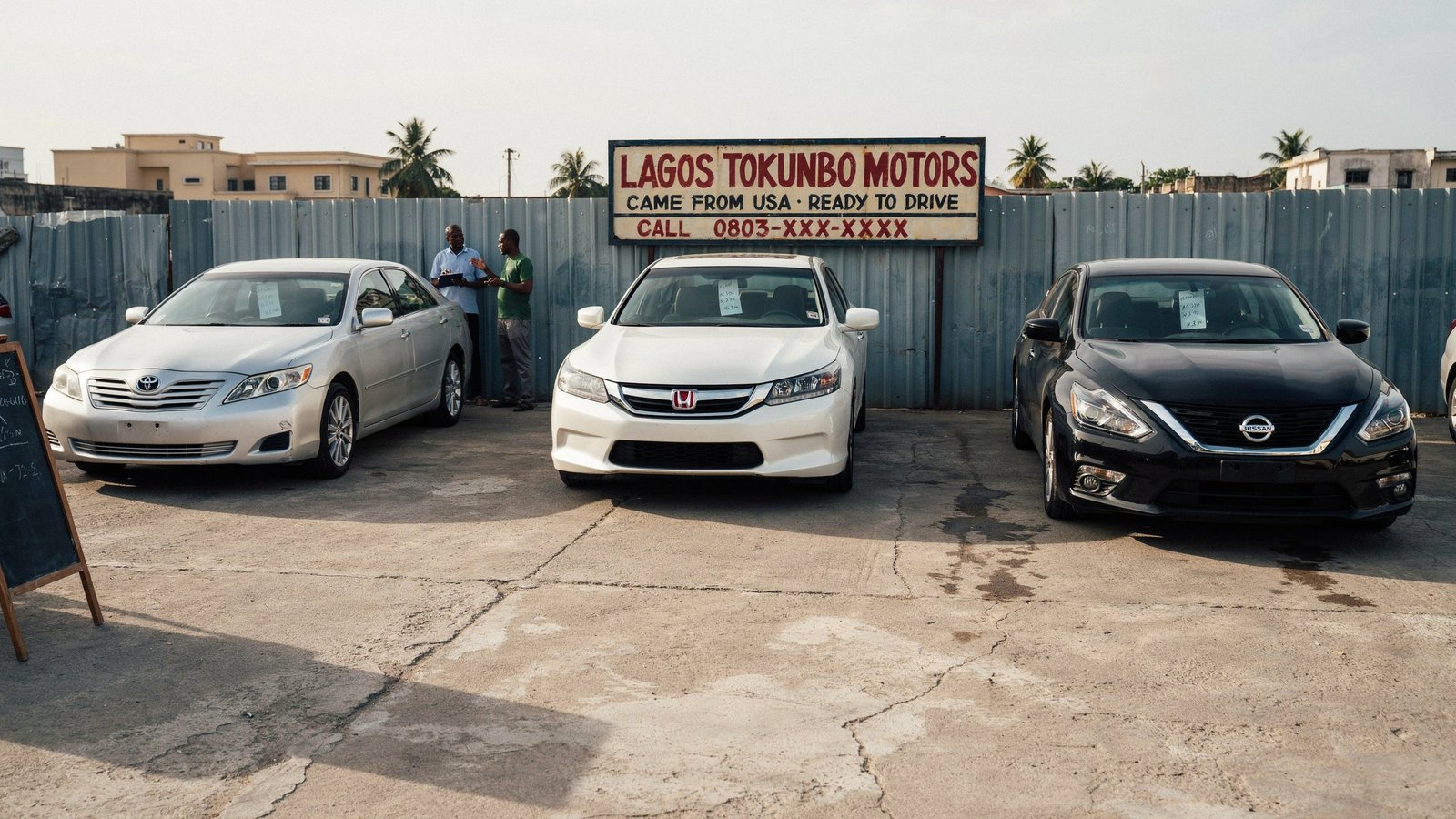

I once sat in on a debate at a mechanic’s shop in Ikeja that lasted longer than the actual repair job. Two customers, one Toyota man, one Honda man, going back and forth about which brand was “more sense” for Nigeria, while the mechanic — who fixes both, and Nissans too — just laughed and said, “una both dey right, e just depend on wetin una want.” That stuck with me, because it’s the honest answer. There’s no single best Japanese car for Nigeria. There’s a best one for you, depending on what you are actually optimizing for.
If you are trying to decide between Toyota, Honda, and Nissan for your first tokunbo purchase, here is a proper breakdown — not brand loyalty, just what each one actually brings to the table on Nigerian roads.
Note: this comparison reflects general, widely-held patterns in the Nigerian tokunbo market. Availability and pricing for any specific model shift over time and by location, so always verify current parts availability and pricing at Ladipo, Berger, or your local market before deciding.
Why Japanese Cars Dominate the Nigerian Used Car Market
Walk through almost any car lot in Lagos, Abuja, or Port Harcourt and you will notice the pattern immediately — Japanese brands make up the overwhelming majority of what is on offer. It’s not an accident. Japanese cars built a reputation over decades for reliability under tough conditions, and Nigerian roads — potholes, heat, humidity, long stretches without proper servicing — are about as tough a test as a car can face. Add to that a mature ecosystem of mechanics who have spent their whole careers working on Toyotas, Hondas, and Nissans, plus a steady supply of spare parts, and you get a self-reinforcing cycle: Japanese cars are easy to maintain here because so many Japanese cars are already here.
Toyota: Camry, Corolla, RAV4
Toyota is, without much argument, the default choice for a huge number of first-time Nigerian car buyers and there is a reason it’s the default rather than just a popular option.
Reliability: Toyota’s reputation for mechanical reliability is well-earned. The Camry and Corolla in particular are known for running well past the mileage where other cars would be showing serious problems, provided they have been reasonably maintained.
Parts availability: This is where Toyota genuinely stands apart. Walk into almost any spare parts market in Nigeria and Toyota parts are the easiest to find, often at the most competitive prices, simply because there is so much demand and supply built around the brand.
Resale value: A well-maintained Toyota tends to hold its value better than most alternatives on the Nigerian market. When it’s time to sell, Toyota badges attract buyers faster, which matters a lot if you think you might upgrade in a few years.
The trade-off: Because Toyota is the “safe” choice, popular models can command a slight price premium over comparable Honda or Nissan options — you are paying a little for the peace of mind and resale advantage.
Honda: Accord, Civic, CR-V
Honda has a loyal following in Nigeria for good reason — it often delivers a noticeably more engaging driving experience without giving up much on the practical side.
Performance: Honda engines have a reputation for being a bit livelier than the Toyota equivalent — the Accord in particular is often praised for how it drives, not just how it holds up.
Fuel economy: Generally competitive with Toyota, sometimes slightly better depending on the specific model and engine, which matters a great deal if your daily driving involves heavy Lagos or Abuja traffic.
Maintenance costs in Nigeria: This is the honest trade-off with Honda — parts are readily available, but typically a notch more expensive than equivalent Toyota parts, and not every corner mechanic has the same depth of Honda-specific experience that they do with Toyota. It’s still very manageable, just not quite as effortless.
The trade-off: You are getting a genuinely enjoyable car to drive, at a slightly higher long-term maintenance cost and a marginally smaller (though still substantial) pool of specialist mechanics compared to Toyota.
Nissan: Altima, Sentra, Pathfinder
Nissan tends to be the value play in this comparison — often the most affordable entry point into the Japanese tokunbo market, with some specific caveats worth knowing upfront.
Affordability: Nissan models frequently come in cheaper than comparable Toyota or Honda options, which makes them attractive to buyers working with a tighter budget for their first car.
Common problems in Nigeria: This is the honest part dealers won’t always volunteer — certain Nissan models, particularly older Altimas, have had reported transmission issues (especially with CVT gearboxes) that are worth specifically checking for during inspection. This isn’t true of every Nissan, but it’s common enough in the market that it deserves extra attention during a test drive and inspection, not just a quick spin around the block.
The trade-off: You get real savings upfront, but the research and inspection burden is higher — you need to be more thorough, particularly around the transmission, before you commit.
Which Brand Has the Best Parts Availability in Nigeria?
Toyota, without much competition. The sheer volume of Toyota vehicles already on Nigerian roads means parts markets are deepest and most competitively priced for this brand. Honda comes next, well-supported but a step behind. Nissan parts are generally available too, though for certain models. However, for transmission components especially, sourcing can take a bit more effort and cost more.
Which Brand Holds Its Value Best?
Toyota again tends to lead here, particularly the Camry and Corolla, which have strong, consistent demand on the resale market. Honda holds value reasonably well too, especially the Accord and CR-V. Nissan resale values are typically the most affordable across the board which cuts both ways: cheaper to buy, but generally less to recover if you sell later.
Which Brand Is Cheapest to Maintain?
Toyota, for the combination of parts pricing and mechanic familiarity — this is really the category Toyota was built to win in a market like Nigeria’s. Honda sits close behind — a bit pricier on parts, but not by a dramatic margin. Nissan can actually end up costing more over time than its lower purchase price suggests, specifically if you land a model with the transmission issues mentioned above, so factor that risk into your total cost thinking, not just the sticker price.
A Clear Recommendation Based on Buyer Priorities
There is no universally “best” answer here — it genuinely depends on what you are optimizing for:
- If budget and low-stress ownership matter most: Toyota. It costs a bit more upfront but gives you the smoothest ownership experience, the deepest parts market, and the best resale value if your priorities shift later.
- If you want a livelier drive and don’t mind slightly higher running costs: Honda. You’ll enjoy the car more day-to-day, and maintenance is still very manageable in Nigeria.
- If your budget is tight and you’re willing to inspect thoroughly: Nissan can be genuinely good value — just be extra diligent about the transmission during inspection, and factor a bit more research time into your buying process.
Whichever brand you lean toward, the decision matters less than the inspection you do before paying. A great brand choice on a badly-maintained individual car will still cost you. Also, brand reputation describes the model, not the specific vehicle sitting in front of you.
Choose the Right Car, the Right Way
Brand is only half the decision — the specific car in front of you is the other half, and that is where a proper inspection separates a good buy from a mistake wearing a trusted badge. Our Nigerian Car Buyer’s Japanese Brand Intelligence Guide goes much deeper into model-specific strengths, weaknesses, and what to watch for across Toyota, Honda, and Nissan — pairing well with our Used Car Inspection Guide so you are equipped to choose both the right brand and the right individual car.
Want a complete checklist you can use at your next car inspection? Download your free Smart Buyer Quick Reference Card Pack — the exact checklist experienced Nigerian car buyers use before paying for any used car.